Table of contents
Education and acquisition belong in the same programme Two ways to make education useful Build a product-led first-purchase journey Make replenishment responsive to the customer Give subscription its own logic Carry creator and retail discovery into CRM Read the cohort behind the channel report Prioritise three tests Questions nutrition brands ask Build the customer journey around the product Sources and methodA first-time sports nutrition customer often needs help before they need another offer. They may be choosing between formats, learning how a product fits their training or finding out whether it suits them. Email can make that experience easier when the journey follows the product they actually bought.
The practical goal is to connect acquisition with a useful first experience and an appropriate next purchase. Build the flow around first product, quantity, customer feedback and subscription status, then measure the resulting cohort over a realistic period.
Education and acquisition belong in the same programme
Klaviyo's 2026 benchmark page reports that flows produced nearly 41% of email revenue from 5.3% of sends, across its benchmark population. That is an observational platform comparison, not proof that adding a flow causes the same result for a nutrition brand. Klaviyo email benchmarks.
The useful implication is to examine moments of intent and need alongside your broadcast calendar. A customer comparing products or receiving their first order is in a different situation from someone reading a general newsletter.
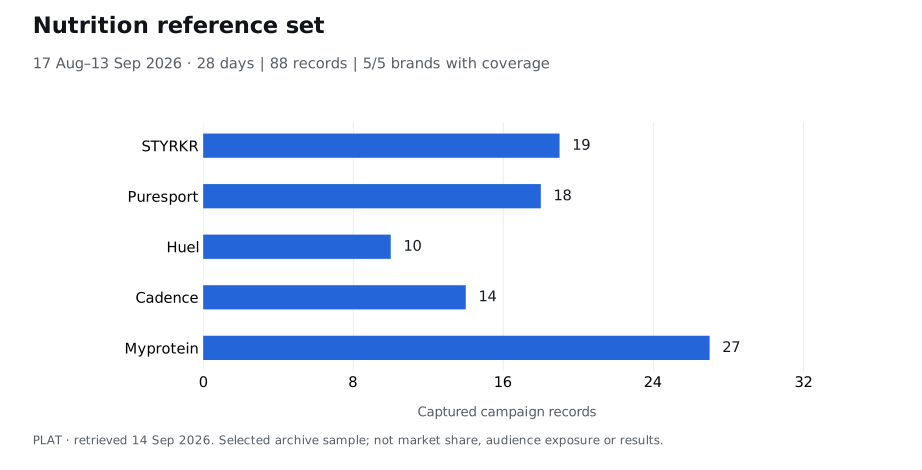
Our recent PLAT cohort contains 88 captured campaign records across STYRKR, Puresport, Huel, Cadence and Myprotein during 17 August–13 September 2026.
Two ways to make education useful
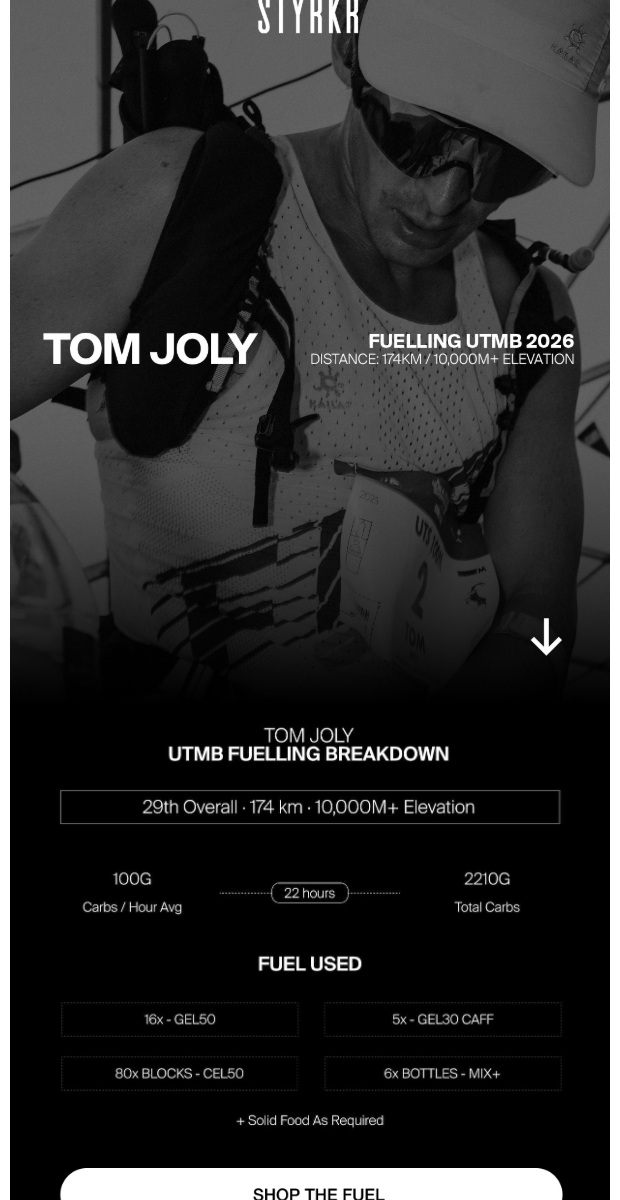
STYRKR's Tom Joly UTMB campaign connects an athlete's account with the products used during an event. The structure moves from a recognisable sporting context to a practical explanation and a shopping route. The athlete's reported intake is individual context, not a prescription for the reader.
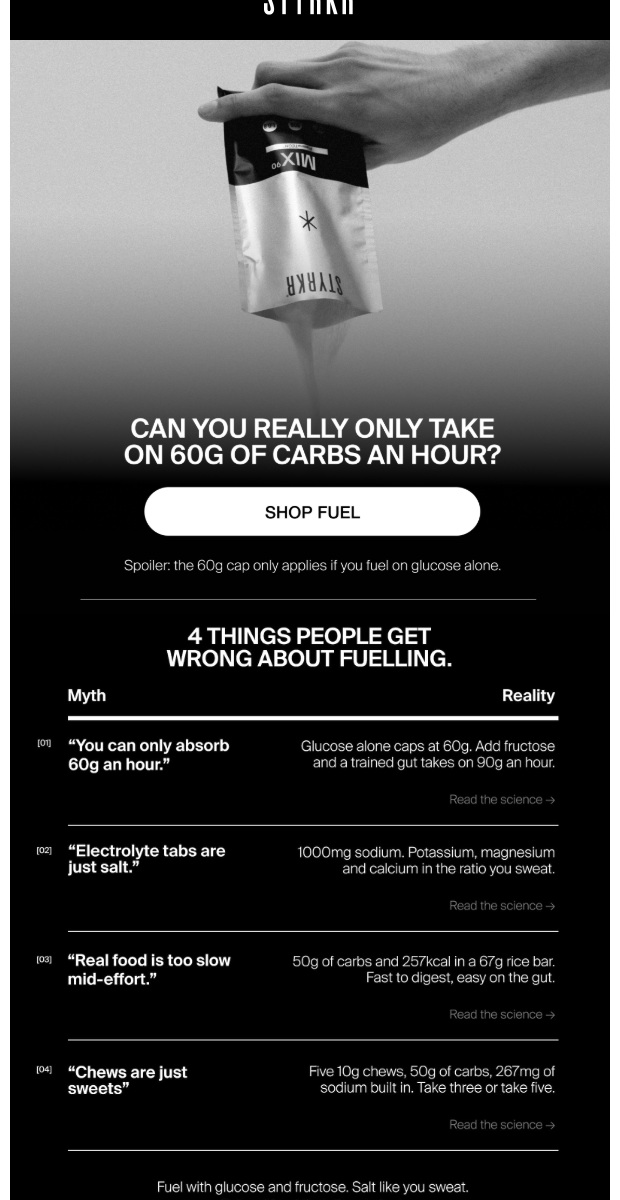
Its “Myth vs reality” campaign uses a different structure: a common question, a short answer and routes to more product information. The format gives the email a clear learning task. Scientific and product statements in the source are campaign claims; they need their own verification before adaptation.
The application is to choose one question appropriate to the customer's stage. A newcomer might need a format comparison. A delivered customer might need preparation or storage help. An experienced customer may want a new use case or product option.
Build a product-led first-purchase journey
Before the order
Use a welcome flow to orient eligible new subscribers. Ask for one useful preference, such as the activity or product format they are interested in. Avoid collecting health information you do not need.
Follow up with a short comparison and the brand's approved product information. Keep eligibility for any offer visible. If the customer buys, move them out of the first-purchase route and use the actual order to determine the next step.
For browse and checkout reminders, recognise the difference in intent. A product view may justify one useful explanation where tracking and eligibility support it. An incomplete checkout can justify help with the specific order. Give purchase events priority over both.
After the order
Use reliable order and delivery states. The first marketing message after confirmed delivery should help with the purchased product, not introduce an unrelated range.
| First product or order type | Useful onboarding | What to ask later | Appropriate next route |
|---|---|---|---|
| Energy gels or chews | Approved storage and use information for that format | Whether the format suited the customer | Relevant reorder, format comparison or support |
| Drink powder | Clear preparation and portion information from the label | Whether preparation and taste were clear | Reorder or another appropriate product |
| Hydration product | Product-specific mixing and storage guidance | Whether instructions were useful | Relevant education or customer-selected replenishment |
| Mixed starter set | Explain the role of each included product | Which items the customer prefers | A focused follow-up based on their answer |
| Subscription | Explain the next shipment and controls | Whether interval and quantity fit their needs | A suitable renewal, adjustment or service route |
These are communication jobs, not individual nutrition advice. Source the actual instructions from current labels and approved brand material.
After the first experience
A short experience check can help customers who would otherwise disappear. Ask whether they have tried the product and whether they need help. If they report a problem, route to support and suppress sales prompts while it is unresolved.
Do not interpret an unopened email as proof of non-use. Use customer answers and purchase events where available, and retain unknowns where they are not.
Make replenishment responsive to the customer
An order date is a starting point, not a depletion forecast. Quantity, product mix and actual use can all change the appropriate interval.
A useful planning model is:
Estimated days of supply = usable servings purchased ÷ customer-declared servings used per week × 7.
Keep this clearly labelled as an estimate. It is most useful when the inputs are known and the customer can adjust them. For multi-product orders, estimate each relevant product separately; do not add unrelated servings together.
Where usage is unknown, use your own observed reorder distribution as a broad testable starting point. A median calculated only among repeat buyers describes repeat buyers; it does not prove when everyone else will return. Show repeat probability and sample size alongside the timing.
For a BFCM stock-up order, extend the analysis to a sensible horizon. A larger initial quantity may delay the next order. Avoid treating a customer with unused stock as a failed retention case.
Give subscription its own logic
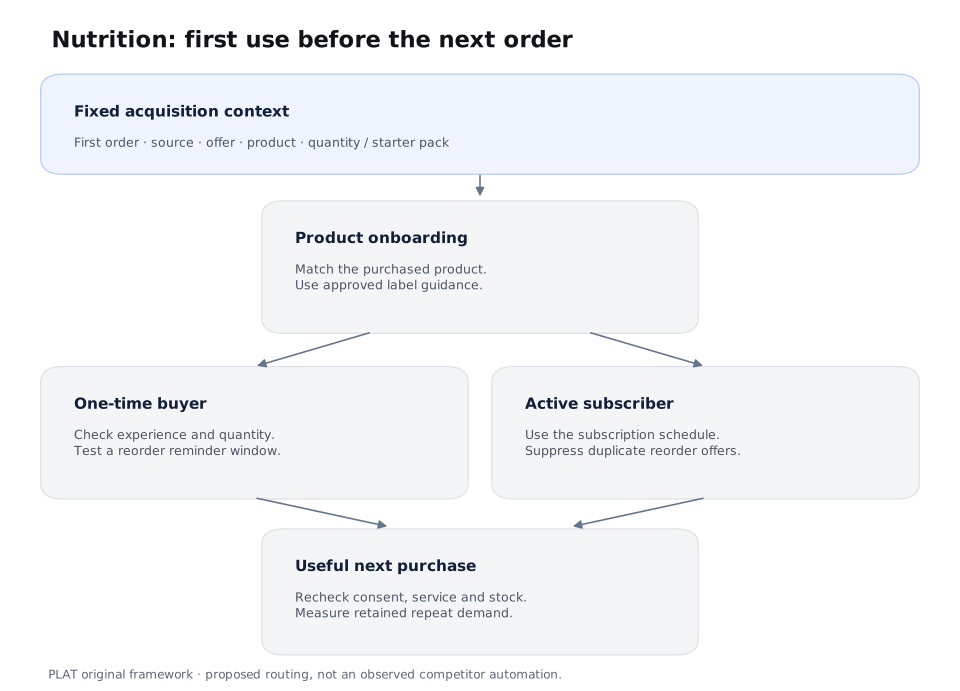
Active subscribers should not receive a generic reminder to buy the product already scheduled for their next shipment. Use the subscription provider's actual events to support renewal, skipping, interval changes or payment recovery where those capabilities exist.
Measure the second and third successful paid renewals, cancellations, skips and refunds. “Active” status and a paid renewal are different facts. A skip can be a useful adjustment rather than churn; read it alongside later payments and customer feedback.
If you offer subscription after a one-time purchase, explain why it could suit the customer and how it works. Avoid disguising a continuing commitment as a one-off discount.
Carry creator and retail discovery into CRM
The Bloom playbook describes creator-led discovery spreading across several purchase channels. The lesson for lifecycle planning is continuity: preserve the product story that introduced someone to the brand while recognising that your store does not observe every later transaction. Open Residency, Bloom playbook, pp. 6–7.
An original route to test could be a creator demonstration leading to a focused product page, an optional product-guide signup and onboarding for the eventual first purchase. Use permissioned creator assets and approved claims. Include product, creative theme and acquisition source in the analysis where they are available.
If retail shoppers join through a QR code or a stockist page, give them content useful for the product they already have. Do not automatically send a new-customer discount or count them as a known DTC purchaser. Separate “retail discovery reported” from a verified store order.
The AI planning pack for this guide: the article, source ledger, exact sample counts, an input checklist and an implementation prompt. Upload it to Claude, ChatGPT or any AI you use.
Download the AI packRead the cohort behind the channel report
Keep a fixed acquisition record and a changing customer state.
| Fixed at acquisition | Updated through the relationship |
|---|---|
| First valid order month or campaign window | Number of subsequent valid purchases |
| Original product and quantity | Current product interests and declared usage |
| First offer and paid acquisition source, where known | Subscription status and successful renewals |
| Initial one-time or subscription purchase | Delivery and service state |
| Original landing-page or creative theme, where known | Marketing eligibility and preferences |
Assess 30-, 60-, 90- and 180-day outcomes only where the group has had time to reach them. Use a consistent customer identifier and denominator. Count a second commercial order once per customer; replacement shipments and zero-value exchanges should not inflate repeat purchase.
For each cohort, report new customers, net retained sales, contribution after variable costs and the acquisition spend allocated to that group. Explain the allocation method. A campaign's attributed revenue can overlap with other channels and should not be added to every other platform's report.
The important comparison is whether a route produces customers whose later value justifies its cost. A cheap creator click is not automatically a cheap customer. A high first-order basket is not automatically a strong renewal cohort.
Prioritise three tests
1. Product-specific onboarding: compare it with the current generic message, keeping offer and eligibility consistent. Measure support issues and mature repeat contribution.
2. Customer-adjustable replenishment: compare a declared or adjustable interval with the current fixed delay. Measure relevant purchases, opt-outs and unwanted-order contacts.
3. A focused starter set: compare the product-choice journey with a broad catalogue destination. Measure contribution and product experience before increasing traffic.
Assign one customer-level experiment where possible and keep groups stable. Use a holdout that receives the existing experience, while preserving service messages. Predefine the window; small cohorts may need more time and may not support a precise causal conclusion.
Questions nutrition brands ask
Can the same post-purchase email serve the whole range?
A common structure can, but the product information should match the order. A powder, chew and starter set have different questions to answer.
When should we ask for a review?
After the customer has had a reasonable opportunity to experience the product. Keep service help available and avoid asking only satisfied customers for a public review.
Can athlete content supply the product claims?
An athlete's experience can provide context, but it does not substantiate general health or performance claims. Review final food and supplement communications against current approved information and applicable rules. CAP food and supplement rules.
Build the customer journey around the product
My CRM work includes STYRKR. I help sports nutrition brands connect useful creative, segmentation and post-purchase flows, with measurement that follows customers beyond the first campaign.
I run the email engine for STYRKR and help nutrition brands turn first orders into routines. Bring your calendar, flows and current numbers; we will map the programme on the call.
Arrange a sports nutrition lifecycle call →Prefer email? george@platagency.com
Download the sports nutrition lifecycle AI pack. For peak-season planning, read the sports nutrition BFCM guide. Explore PLAT campaign research.
Sources and method
Research reviewed 14 September 2026. Recent PLAT figures use five canonical brand queries over 28 inclusive days. Campaigns are brand-level records, can include variants and may carry import dates. Two STYRKR visuals and their extracted text were inspected. They show educational creative, not the brand's actual automation or measured impact. No customer-level retention data was available. Cohort definitions, supply calculations and proposed tests are original analytical guidance; example use rates are not product recommendations. Interview lessons remain attributed accounts.
Bring this to your brand.
I run the email engine for STYRKR and help nutrition brands turn first orders into routines.
Arrange a sports nutrition lifecycle call Or email george@platagency.com