Table of contents
Read the seasonal evidence in context Three campaigns with different purchase jobs Choose the acquisition route before the offer depth Check the economics of the pack A 2026 plan that continues after the sale Build the onboarding flow before BFCM traffic arrives Measure the customer after the first basket Questions nutrition teams ask Turn the plan into a working programme Sources and methodA sports nutrition brand can acquire very different customers during Black Friday: someone trying a gel for the first time, a regular buyer increasing their basket, or a shopper starting a subscription. Those purchases need different explanations and different follow-up.
The strongest planning question is what the offer asks someone to do next. Trial needs product confidence. A larger basket needs a credible use case. Subscription needs clear terms and a suitable ongoing rhythm. This guide connects those choices to campaigns, flows and the cohort you will measure after BFCM.
Read the seasonal evidence in context
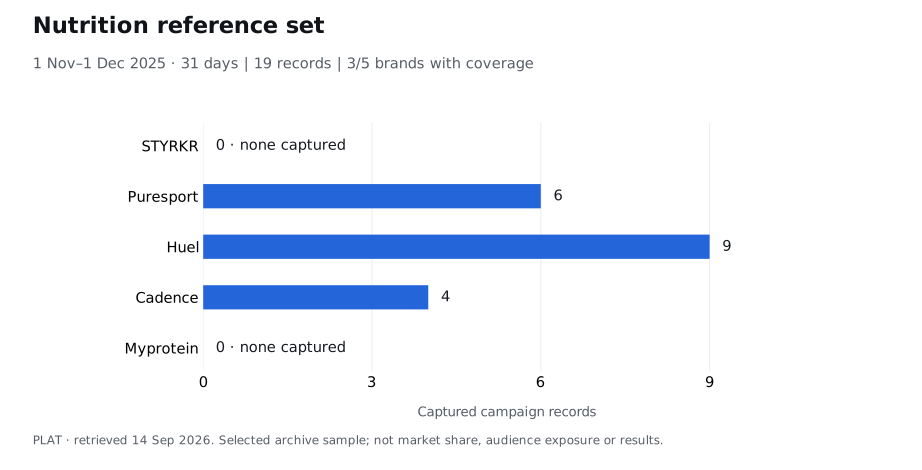
For 1 November–1 December 2025, PLAT returned 19 captured campaign records across three of five queried nutrition and performance brands: Huel nine, Puresport six and Cadence four. STYRKR and Myprotein had no captured records in that window. Missing records do not establish that those brands were silent.
The wider opportunity is real, but it should not become a forecast for your store. Shopify reported $14.6 billion in global merchant sales during BFCM 2025, up 27%, and listed fitness and nutrition among its hottest categories. Those are platform-wide results. Shopify BFCM results.
Three campaigns with different purchase jobs
Huel separates the entry offer from continuing value
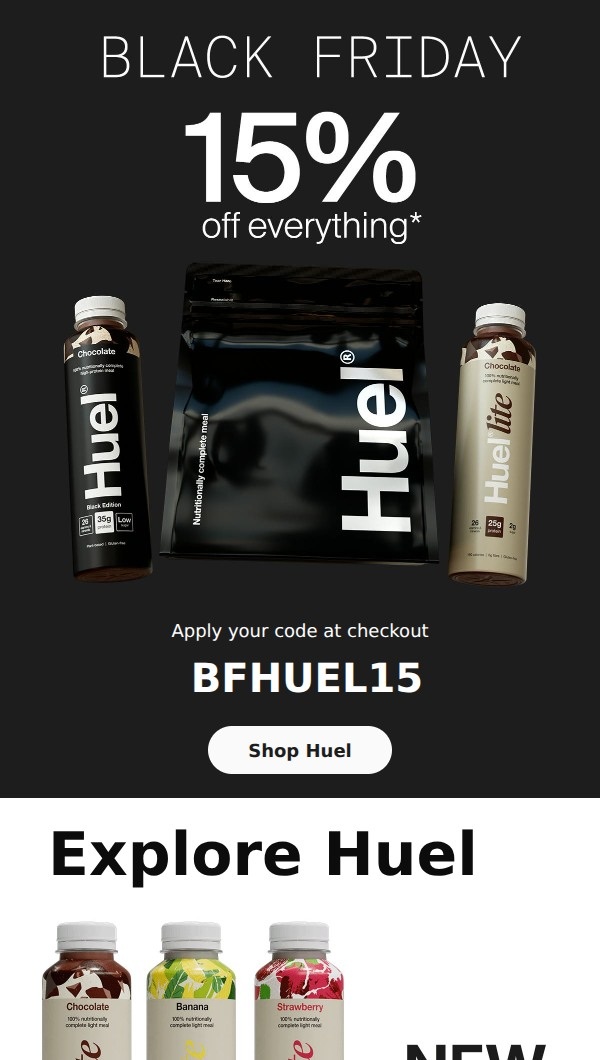
Huel's archived Black Friday email makes its 15% code highly visible. The extracted terms restrict the offer to new customers and explain its relationship with regular subscription savings. That eligibility matters as much as the headline.
For your brand, decide whether the entry offer is designed to encourage a first one-time order or a subscription. Explain the purchase type before checkout. Keep existing subscribers out of new-customer messaging that does not apply to them.
A discount on the first shipment does not establish that a subscription is attractive over several renewals. Show future pricing, expected timing and customer controls clearly. Measure successful paid renewals rather than treating every subscription checkout as retained revenue.
Puresport gives the larger basket a reason
Puresport's three-for-two reference frames the supplement basket around maintaining a routine into the new year. The visual connects the products, the offer and the next action rather than leaving the customer to assemble the meaning.

The useful lesson is basket architecture. A first-time endurance customer may need a small set they can understand and try in training. An experienced buyer may want familiar products in a larger quantity. Making both customers navigate the same oversized bundle can create friction.
Cadence names the roles within a system
Cadence's historical email describes a 30-sachet set across Core, Race and Sleep products, with a 15% code. The observation here comes from the extracted email body; a usable visual render was unavailable. View the campaign.
The transferable idea is to explain why each item belongs in the set. Your application should use approved product information and suitable usage guidance. A competitor's performance or health language is not evidence for your own claims.
Choose the acquisition route before the offer depth
| Route | Best starting question | Landing-page job | Follow-up job |
|---|---|---|---|
| First-time trial | What will help them choose confidently? | Explain format, contents and intended use | Product onboarding and an early experience check |
| Familiar-product basket | What quantity is useful and commercially sound? | Make pack size and value clear | Timing based on likely need, with customer control |
| Subscription | Is ongoing delivery appropriate for this customer? | Explain renewal price, interval and controls | Support the next successful paid renewal |
| Retail or creator discovery | What do they already know and what is missing? | Continue the exact product story | Relevant education and optional preferences |
Keep the original creative angle attached where your analytics allow it. A visitor acquired through a race-day demonstration should not land on a generic supplement wall. They should see the relevant product, its approved information and the choice they were promised.
A useful original brief for a trial route is “Choose your training fuel”: a clear product comparison, a small starting selection and an invitation to ask a question. For a repeat buyer, the brief may simply be “Your familiar products, ready for the next block”. These are proposed directions, not observed winning copy.
Check the economics of the pack
Dom Iacovone's interview playbook stresses price-pack architecture and the effect of discounts and channel costs on contribution. Apply the principle by costing the exact BFCM basket and its follow-up obligations. The playbook's named contribution layers are specific to its account; define your own cost basis consistently. Open Residency, Dom Iacovone playbook, pp. 5–6.
For each proposed offer, calculate net sales after discount and expected refunds, then subtract product costs, gifts, payment fees, variable fulfilment and shipping subsidy. Compare the remainder with acquisition cost. Include subscription renewal economics separately.
Do not justify an unprofitable first order with an invented lifetime value. Use mature customer cohorts from your own business or show the repeat-purchase assumption explicitly as a scenario.
Also account for buying ahead. A larger basket can bring revenue forward and extend the time to the next order. That is not automatically a retention failure, but it changes how you read the cohort.
A 2026 plan that continues after the sale
Black Friday falls on 27 November and Cyber Monday on 30 November. The sequence below is a proposed planning structure.
| Period | Work or message | What changes by customer |
|---|---|---|
| 19 October–1 November | Cost offers and choose priority products | Trial, repeat and subscription propositions |
| 2–15 November | Build journeys and product-choice content | Product familiarity and consented interests |
| 16–22 November | Explain the range and upcoming access | Newcomer guidance versus familiar-product previews |
| 23–26 November | Open any genuine early access | Defined members and eligible existing customers |
| 27 November | Launch the offer | Correct purchase type and terms |
| 28–30 November | Resolve product choice and close accurately | Non-buyers, current stock and actual deadlines |
| After delivery | Help customers begin using the product | First product, experience and support needs |
| Following weeks and months | Review need and subsequent orders | Quantity, subscription status and cohort maturity |
A customer who buys on Friday should move into the appropriate order journey. They may still receive relevant marketing later, but should not keep receiving the same first-purchase prompt as if nothing happened.
Build the onboarding flow before BFCM traffic arrives
| Trigger or checkpoint | Proposed message | Exclusions and dependencies |
|---|---|---|
| Eligible signup | Product-choice guide and applicable offer | Existing buyers and subscribers take their own routes |
| Uncompleted checkout | Clarify products, format and delivery | Exit on purchase; recheck stock and terms |
| Delivery confirmed | Approved preparation, storage and usage information | Reliable delivery event or careful fallback wording |
| Several days after delivery | Ask about experience and offer help | Service concerns take priority over selling |
| Customer indicates ongoing need | Relevant reorder or subscription explanation | Quantity, current subscriptions and previous purchases |
| Renewal approaching, where supported | Clear shipment and customer controls | Use actual subscription-provider events |
The timing should be a testable hypothesis, not a universal day-30 rule. Do not send a gel customer powder-preparation content because both products share a broad category tag.
Educational claims need particular care. Use current, authorised product information and the applicable conditions of use; avoid diagnosing needs or copying competitor physiological claims. CAP food and supplement rules.
The AI planning pack for this guide: the article, source ledger, exact sample counts, an input checklist and an implementation prompt. Upload it to Claude, ChatGPT or any AI you use.
Download the AI packMeasure the customer after the first basket
Define a fixed BFCM acquisition cohort from first valid orders within your own promotion window. Keep acquisition route, first product, quantity, offer and purchase type as historical attributes. Update current lifecycle status separately.
| Acquisition group | First useful outcome | Later useful outcome | Common misreading |
|---|---|---|---|
| Trial buyer | A retained first order and useful product experience | Second purchase or a suitable subscription | Calling every non-reorder at day 30 churn |
| Larger-basket buyer | Contribution after discount and fulfilment | Reorder after a plausible product cycle | Mistaking purchases brought forward for lost retention |
| New subscriber | First shipment retained | Second and third successful paid renewals | Counting active status as paid retention |
| Creator-acquired buyer | First-order value by the original product story | Mature contribution by acquisition source | Assigning all cross-channel sales to the creator |
Compare cohorts at the same age. A 60-day repeat rate needs 60 days of observation for every included first-order customer. A customer who refunds remains part of the acquisition result; the refund reduces value.
For an analytical illustration, assume a customer reports three relevant sessions per week and uses one serving per session. A 30-serving order would cover ten weeks under those assumptions. This is a quantity-planning example, not nutrition advice or a known customer's behaviour. It shows why an automatic day-30 refill prompt can be premature.
Read repeat orders alongside product satisfaction, service contacts and contribution. Where retail purchasing is unobserved, label it unknown. An email address does not reveal purchases made at a stockist.
Questions nutrition teams ask
Should new customers receive the largest bundle?
Only if it makes the decision easier and suits the product. A curated trial may produce a more useful customer relationship than a high-value first basket that is never used. Test the proposition and follow its cohort.
Should we stop subscription messages during BFCM?
Keep essential subscription communications working. Review promotional overlap, current subscribers' eligibility and whether campaign pricing conflicts with renewal expectations.
Which metric should decide whether the offer worked?
Start with contribution after acquisition, then review mature repeat contribution and paid renewal outcomes. Revenue, signup count and attributed return on ad spend provide useful context but do not settle the profitability question.
Turn the plan into a working programme
My CRM work includes STYRKR. I help brands connect product education, campaigns and flows so new customers get a useful start and the business can see what happens after the first order.
I run the email engine for STYRKR and help nutrition brands turn first orders into routines. Bring your calendar, flows and current numbers; we will map the programme on the call.
Arrange a sports nutrition BFCM call →Prefer email? george@platagency.com
Download the sports nutrition BFCM AI pack. Continue with sports nutrition flows for repeat purchase or browse more campaigns in PLAT.
Sources and method
Research reviewed 14 September 2026. Five canonical brands were queried for 1 November–1 December 2025 inclusive. Three had observations; coverage completeness is unknown. Two historical visuals were inspected, with Cadence analysed from extracted body content. These campaigns do not establish the brands' automation logic or commercial results. PLAT category membership is broad and brand counts can include adjacent products. All proposed dates, flows and tests are original recommendations. Supplied founder playbooks inform operating principles, not numerical performance targets.
Bring this to your brand.
I run the email engine for STYRKR and help nutrition brands turn first orders into routines.
Arrange a sports nutrition BFCM call Or email george@platagency.com