Table of contents
What recent PLAT campaigns can tell us Start with confidence in the first pair Build separate launch and restock journeys Give the second purchase a reason Measure what the customer kept Preserve the original acquisition story Connect paid and creator content to the email journey The first four improvements to make Questions footwear teams ask Build a better journey after the first pair Sources and methodFootwear does not behave like a simple refill product. A second purchase may depend on the first pair fitting well, a new colourway, a different occasion or a customer finding a style they could not buy before. A useful lifecycle programme supports those decisions.
The first priority is confidence in the first pair. Then the programme can introduce relevant newness, accurate restocks and a clear reason to return. This guide shows how to connect those moments to customer data and measure retained demand rather than just another order notification.
What recent PLAT campaigns can tell us
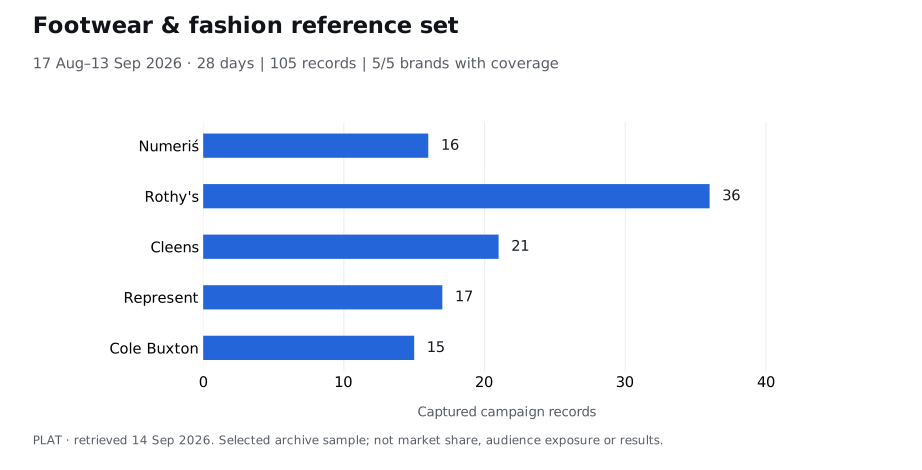
Across 17 August–13 September 2026, PLAT captured 105 campaign records for five selected footwear and premium fashion brands: Rothy's 36, Cleens 21, Represent 17, Numeriś 16 and Cole Buxton 15.
Two Numeris references illustrate different jobs. The Eclipse Cow Brown and Cow Black launch makes new colourways the reason to look at a familiar silhouette. The Atelier Chalk restock gives availability a role in the message.
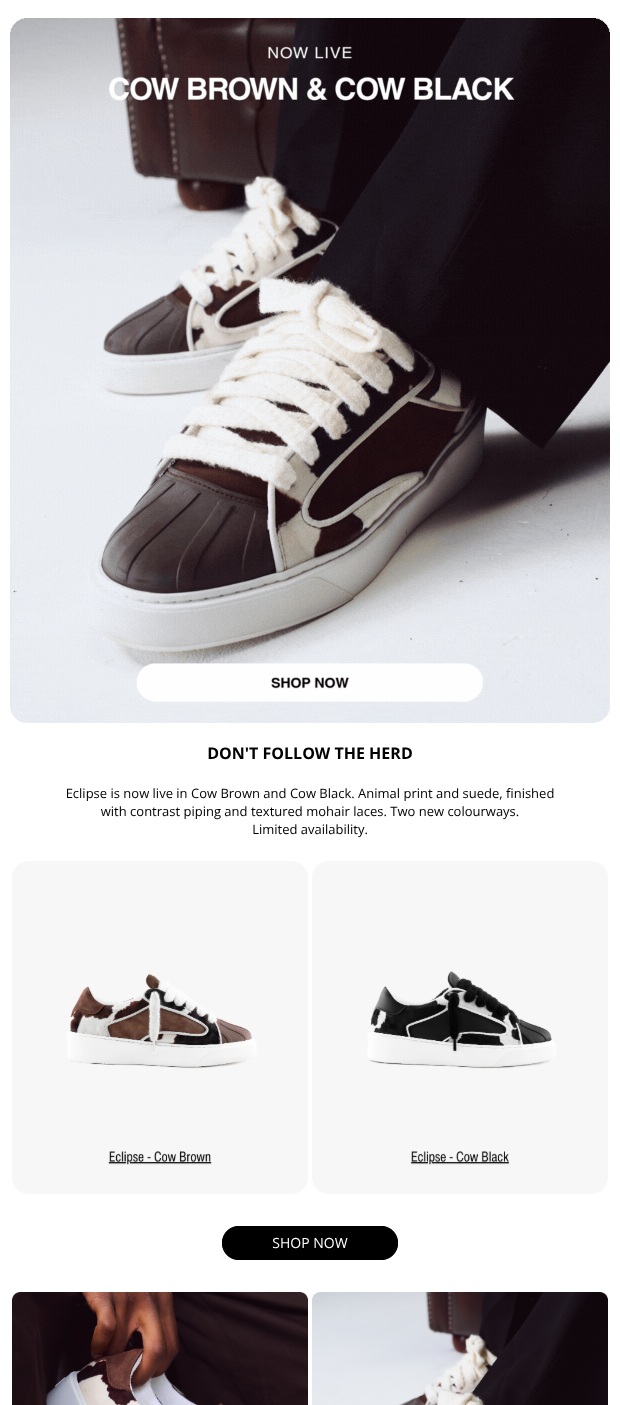
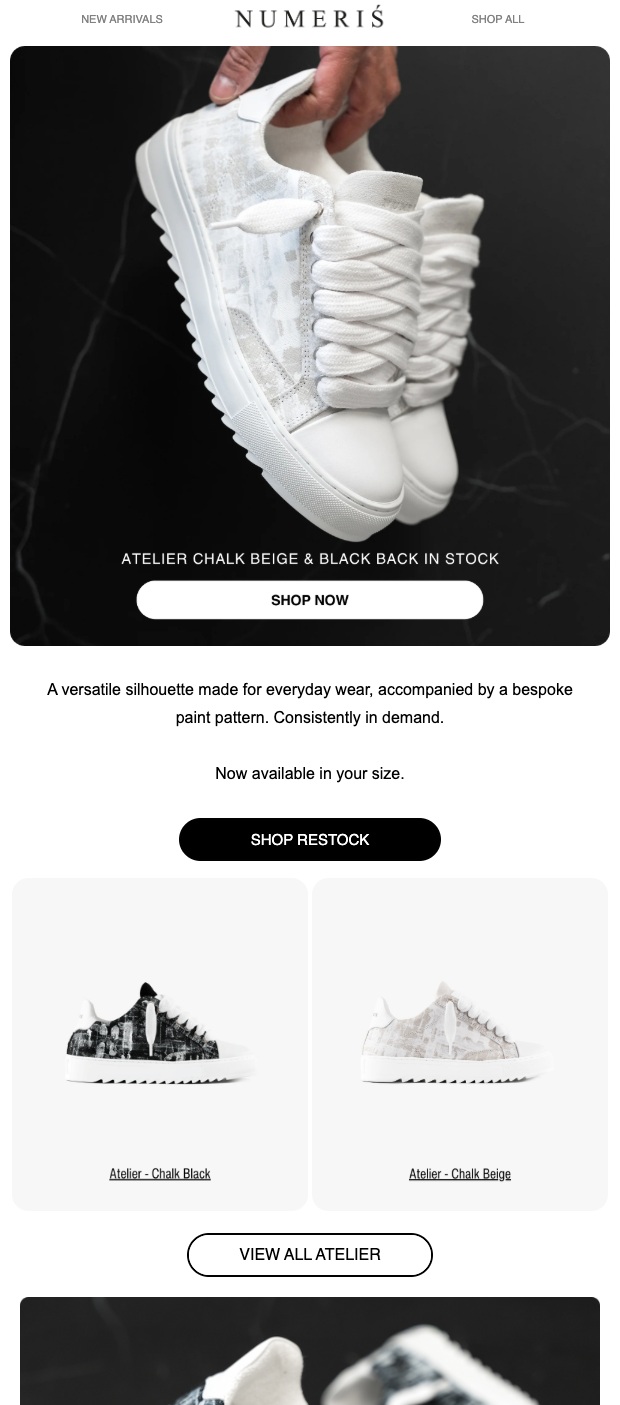
The first story can help someone understand what has changed. The second can help someone act on existing interest. The archive does not reveal whether either message used a dynamic customer segment; the flow suggestions below are original applications.
Start with confidence in the first pair
Welcome through a silhouette or a use case
A new subscriber should quickly understand the range and what distinguishes it. A concise comparison of silhouettes, materials or intended styling can be more useful than a long catalogue.
Offer one optional preference choice. If you ask for size, capture the size system and explain how it improves future messages. Do not treat a previous gift purchase as proof of the buyer's personal size.
Use the customer's later purchase to exit first-order messaging. The welcome route should not keep asking for a first order after the first pair has been bought.
Recover the decision with product information
For a known, marketing-eligible visitor, a product-interest message can answer a relevant question about fit, materials or styling. A checkout reminder should relate to the chosen product and available variant.
Keep the next step easy: an accurate product page, a fit guide or help with the order. Test whether that reassurance helps before adding another discount. Coordinate browse and checkout journeys so the higher-intent event takes priority.
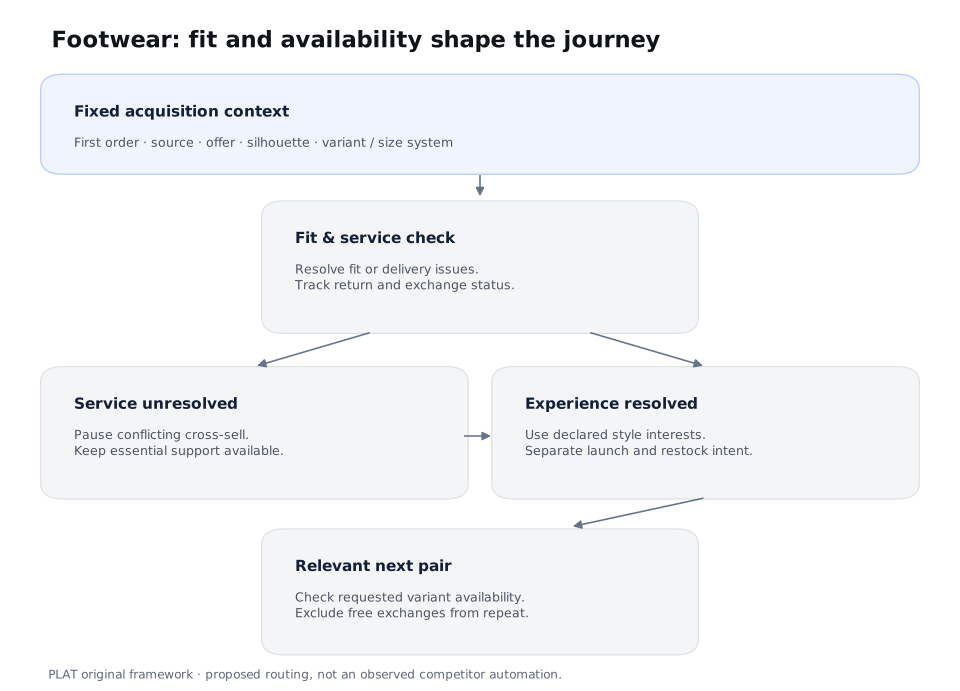
Check the fit after delivery
Once delivery is reliably confirmed, make fit help easy to access. Ask whether the pair is right, explain the relevant next step and provide a clear support route. Keep returns and exchange information accurate for the market and order.
The aim is to resolve uncertainty while the customer is forming their view of the brand. Suppress a second-pair pitch if an exchange, return or unresolved service issue is in progress.
Build separate launch and restock journeys
A launch is a new reason to consider the brand. A restock often serves an existing intention. Treat them separately.
| Journey | Entry signal | Message sequence to test | Important stop rule |
|---|---|---|---|
| New silhouette | Relevant declared or observed interest | Introduction, product context, availability | Purchase or a more relevant current journey |
| New colourway | Relevant style interest or previous retained purchase | What changed, styling context, current options | Product mismatch or purchase |
| Requested restock | A request for a specific variant | Accurate availability notice and, if justified, one follow-up | Stock unavailable or customer already bought |
| Seasonal wardrobe need | Declared preference or relevant engagement | Original styling edit and suitable products | Service issue or irrelevant selection |
The source restock email uses size-led language, but a real automated implementation needs a dependable link between the requested variant and current inventory. Recheck availability close to sending. If the size is gone, replace the destination or stop the message.
Keep a customer's request distinct from a blanket restock campaign. Requested notifications are a more specific relationship and should follow the applicable permissions and platform setup.
The Bloom interview playbook describes restocks as a source of demand evidence. Applied to footwear, the useful principle is to make genuine availability relevant to people who wanted the product. A restock by itself is not proof of popularity, scarcity or profitability. Open Residency, Bloom playbook, p. 8.
Give the second purchase a reason
An automatic “time for another pair” message is rarely enough. Use the product and relationship context.
For a customer happy with a silhouette, a new material or colourway may be relevant. For someone browsing a different occasion, a styling comparison can help. For a customer waiting on stock, the relevant variant matters more than a general launch.
Do not force a recommendation from weak data. A well-edited general selection with clear product differences is better than an inaccurate claim about the customer's preferences.
An original email brief could open with “A different way to wear your favourite silhouette”, show the new option beside the familiar shape, explain the difference in plain language and offer one focused shopping route. Use it only where the customer and product evidence support that description.
The AI planning pack for this guide: the article, source ledger, exact sample counts, an input checklist and an implementation prompt. Upload it to Claude, ChatGPT or any AI you use.
Download the AI packMeasure what the customer kept
Returns are part of the customer journey, not a separate reporting footnote. Track whether an order remains retained and why customers return or exchange it.
| Question | Useful measure | How the definition prevents confusion |
|---|---|---|
| Which product attracts new buyers? | First valid order by entry product | Each customer has one acquisition event |
| Which product creates a good first experience? | Retained first order and service reasons | Refunds remain attached to the original cohort |
| Do buyers return for the brand? | A distinct second commercial purchase | Replacements and zero-value exchanges are excluded |
| Does the repeat demand last? | Retained second purchase at 90 or 180 days | Later refunds can revise the result |
| Does sale acquisition broaden? | Subsequent full-price purchasing with a stated definition | The first offer remains a fixed cohort attribute |
| Is the programme worth funding? | Mature contribution after acquisition costs | Revenue is read alongside product and service costs |
NRF's 2025 research estimated a 19.3% online return rate across US retail. Do not adopt that as a target for your footwear business; use your own product and market data. NRF returns research.
For a worked analytical example, if 100 customers place first valid orders and 20 make a later commercial purchase within 90 days, the gross second-order rate is 20%. If five of those later orders are fully refunded, 15 customers have a retained second purchase at the reporting date: 15%. This is an illustrative calculation, not PLAT or client performance data. Keep the denominator at 100; do not remove disappointed first-order customers to improve the rate.
Preserve the original acquisition story
Store first-order month, first product, original offer and acquisition source as fixed attributes. Track the latest customer state separately: first-pair customer, repeat customer, open return, resolved exchange or current lapse.
A BFCM customer who later buys at full price is still part of the BFCM acquisition cohort. Their new behaviour is exactly what you want to learn from. Overwriting the original source or offer would hide it.
Compare customers at the same age and report the number of customers behind each result. A cohort from last month cannot yet supply a 90-day repeat rate. For seasonal products, use a horizon that can capture the next relevant buying occasion.
A median repeat interval among repeat buyers is useful but incomplete. It excludes those who have not returned. Show the proportion returning as well as the timing, and avoid treating the median as a universal trigger.
Connect paid and creator content to the email journey
Use acquisition creative to answer a product question: what the silhouette looks like on foot, how materials differ or how a pair fits into a wardrobe. Carry that same context onto the landing page and into the first relevant email.
Retain creative theme and source where known. Compare later retained contribution by entry product and acquisition route, rather than judging every creative on the first click or order alone.
Use customer and creator content with permission and enough context to be useful. If a fit statement is specific to one person or size, present it as that person's experience. Do not turn it into a universal promise.
The first four improvements to make
1. Repair purchase suppression. Check that buyers leave conflicting welcome, browse and checkout messages.
2. Add fit and service routing. Use dependable delivery and returns data, with a clear fallback where events are missing.
3. Separate requested restocks from general launches. Map requests to variants and recheck stock before sending.
4. Build one mature cohort view. Start with first-product and first-offer groups, then add source if the data supports it.
Test one change at a time against the existing experience where volume allows. Define the primary measure before launch and keep transactional support available to both groups. Count opt-outs and service issues alongside commercial outcomes.
Questions footwear teams ask
When should we cross-sell a second pair?
After the first experience is understood and there is a relevant product reason. A new colourway or declared interest can be more useful than a fixed delay.
Can purchase history supply the customer's size?
It can suggest a preference, but gifts, exchanges and different silhouettes can make it unreliable. Keep the size system, source and confidence clear, and let the customer update it.
Is a returned customer a lost customer?
Not necessarily. Read the service outcome and subsequent retained purchases. An exchange resolved well can be part of a continuing relationship, but it should not be counted as a second paid purchase.
Build a better journey after the first pair
My lifecycle work includes Numeris. I help footwear and fashion brands connect product storytelling, customer segments and flows, with reporting that follows the retained purchase and the relationship after it.
I run CRM for Numeris and help footwear brands earn the second pair. Bring your calendar, flows and current numbers; we will map the programme on the call.
Arrange a footwear lifecycle strategy call →Prefer email? george@platagency.com
Download the footwear lifecycle AI pack. Preparing a seasonal campaign? Read the footwear and fashion BFCM guide. Explore PLAT campaign references.
Sources and method
Research reviewed 14 September 2026. Five canonical PLAT brand queries cover 28 inclusive days, 17 August–13 September. Archive records may include variants, adjacent categories and import dates. Two Numeris visuals and extracted copy were inspected. They establish communicated messages, not personalisation rules or commercial impact. Customer examples and flow maps are original teaching material. No client retention or return data was supplied. Founder-playbook ideas remain attributed accounts and are not evidence of causal campaign performance.
Bring this to your brand.
I run CRM for Numeris and help footwear brands earn the second pair.
Arrange a footwear lifecycle strategy call Or email george@platagency.com