Table of contents
What the historical reference set contains Give the collection a role before the sale opens Make size availability useful Acquire customers through a better product decision Decide what the promotion is trying to sell A 2026 calendar built around decisions Build the flows that make the campaign credible Measure retained demand after the sale Three tests that can improve the next sale Questions footwear teams ask Build your BFCM customer journey Sources and methodA footwear promotion can generate attention and still waste it if the shopper cannot find their size, understand the fit or see why the product belongs in their wardrobe. Those decisions should shape the email programme before the discount headline does.
For premium footwear and fashion brands, this BFCM guide connects collection storytelling with available stock, customer intent and returns-aware measurement. It uses historical PLAT campaigns to build a 2026 plan that can acquire useful customers without reducing every message to the same sale reminder.
What the historical reference set contains
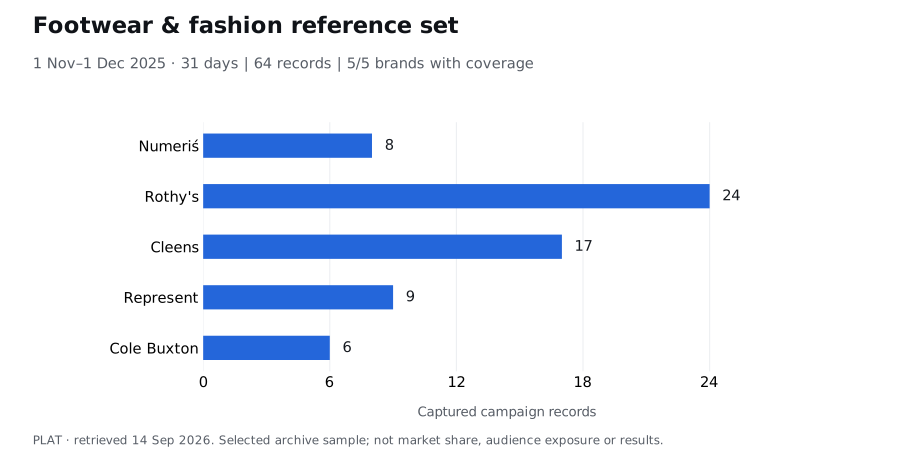
PLAT's canonical aggregates contain 64 campaign records across five selected brands for 1 November–1 December 2025: Rothy's 24, Cleens 17, Represent nine, Numeriś eight and Cole Buxton six.
The useful comparison is between message jobs. Represent makes a collection worth previewing. Numeris gives readers a size-related reason to act. Both can sit within a seasonal programme, but they answer different customer questions.
Give the collection a role before the sale opens
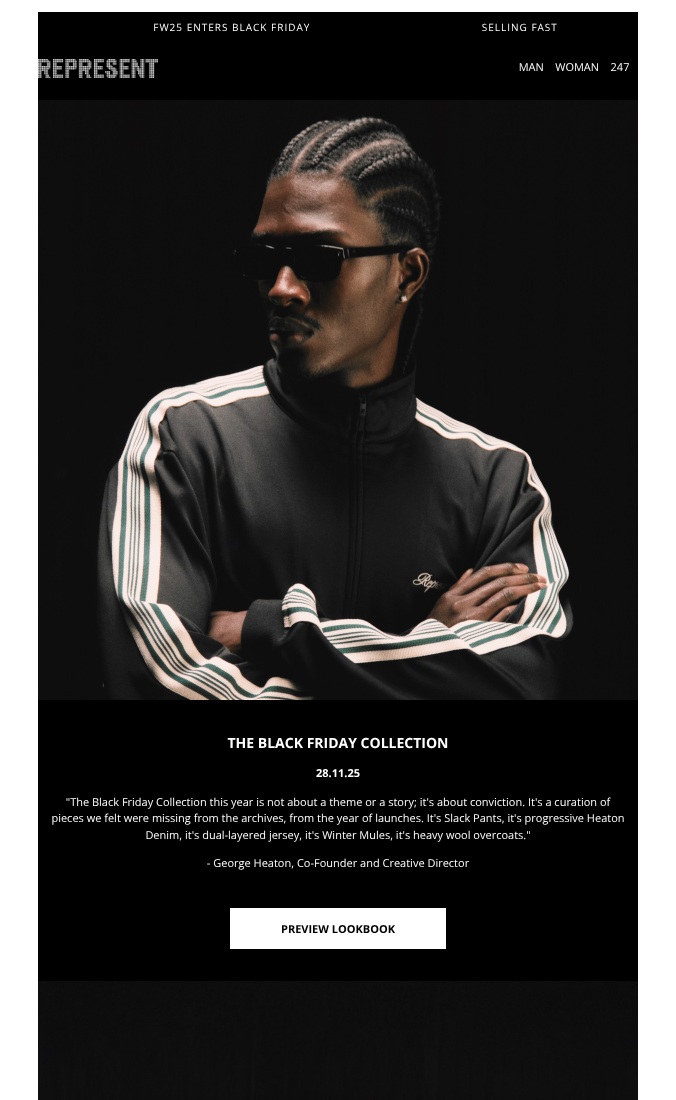
Represent's Black Friday collection preview presents campaign imagery, a dated launch and a route to a lookbook. It also includes a separate section for additions to an existing sale. The email makes a distinction between discovering a collection and shopping currently available pieces.
For your brand, the pre-sale task could be exploring silhouettes, saving a favourite or understanding which collection will be included. Show the product context that will still matter when the price changes.
Separate fresh collection storytelling from clearance. They may share a calendar, but the reason to buy and the stock objective differ. Explain access, availability and inclusions accurately instead of making the entire catalogue look interchangeable.
Make size availability useful
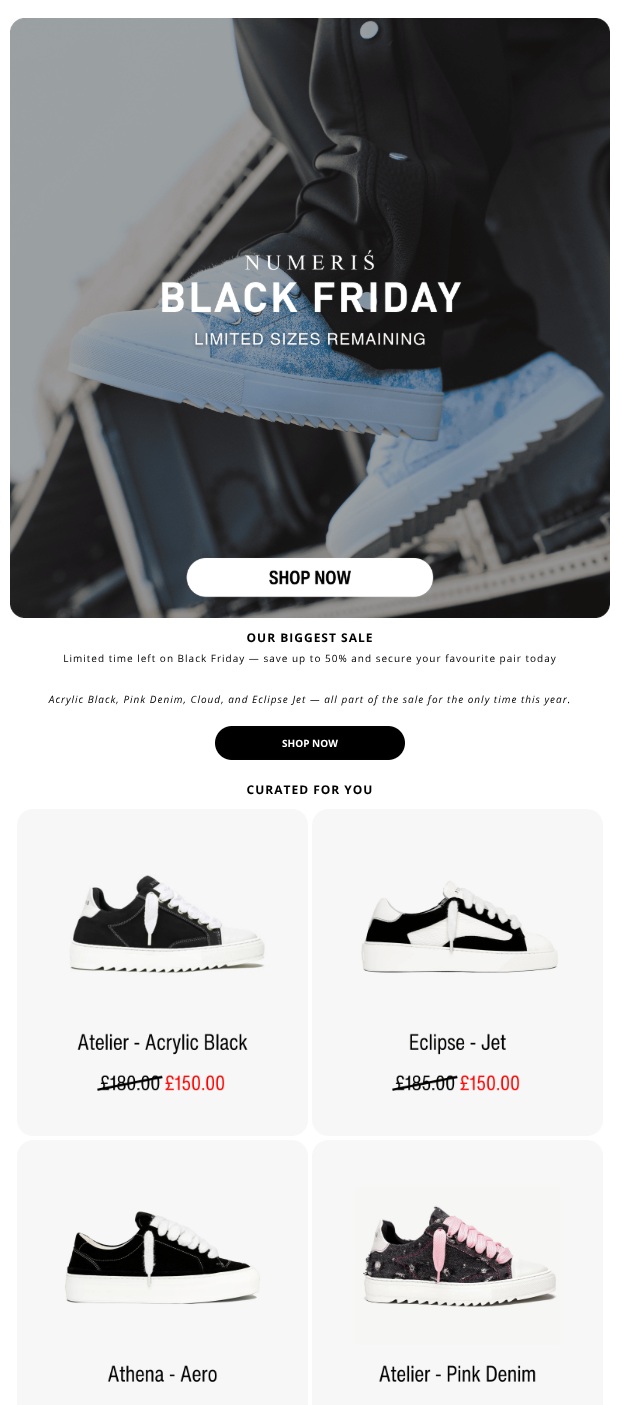
Numeris' historical “Limited Sizes Remaining” campaign pairs the seasonal offer with a product edit. Its subject gives availability a role in the decision, while the body presents a selection of footwear.
The next step for your own programme is to connect that idea to accurate variant data. Where a customer has declared a size or requested a specific restock, direct them to the relevant available products. Where size is unknown, offer a clear “shop by size” route rather than pretending to know it.
Do not infer that the source campaign was dynamically personalised. The archive shows the message and creative, not the data or audience logic behind it.
Acquire customers through a better product decision
| Acquisition angle | Destination | Useful next signal | What the first email should do |
|---|---|---|---|
| A silhouette or collection story | Focused collection preview | Saved product or declared interest | Continue that collection story |
| Fit or styling demonstration | Relevant product page with guidance | Size-system choice and product interest | Answer fit, materials or styling questions |
| Size-led sale discovery | Accurate available-size edit | Declared size and selected products | Show relevant availability |
| Member access | Clear access page | Marketing eligibility and access status | Explain when and what the member can shop |
A useful original creative brief is “Find your pair before the sale opens”: on-foot imagery, a concise silhouette comparison, an accurate preview date and one destination. Keep the product and the opening promise consistent across ad, landing page and email.
If you use creator or customer imagery, show useful fit or styling context with permission. A photograph alone should not become an unsupported claim about comfort, quality or popularity.
Decide what the promotion is trying to sell
Agree whether the primary goal is acquiring new customers, releasing older stock or supporting a collection launch. An all-purpose sale makes it harder to judge the result.
Set the offer at a product or collection level where that reflects the economics. Review stock by variant, not just by style. A popular silhouette with fragmented sizes may have a different opportunity from a well-stocked core line.
The source playbooks offer useful operating principles. Nima Jalali describes premium product value through design and product experience. Roman Khan emphasises the connection between inventory decisions and cash. For footwear CRM, the application is to explain the product and measure the stock outcome together. Salt & Stone playbook, p. 5; Dividend-First playbook, pp. 4–7.
A 2026 calendar built around decisions
| Window | Main job | Critical dependency |
|---|---|---|
| 19 October–1 November | Set inventory and contribution objectives | Variant-level stock, costs and returns history |
| 2–15 November | Build product, size and fit destinations | Accurate size systems and current guidance |
| 16–22 November | Preview the relevant collection | Confirmed products and availability plan |
| 23–26 November | Deliver genuine access benefits | Defined eligibility and working access routes |
| 27 November | Launch Black Friday | Current prices, stock and applicable terms |
| 28–29 November | Help undecided shoppers choose | Relevant size availability, styling or product comparison |
| 30 November | Close at the actual stated time | Remaining stock and a destination that updates |
| December–January | Support fit and fulfilment | Delivery, returns and exchange events |
These are proposed planning windows. Black Friday is 27 November and Cyber Monday is 30 November. Check each message against the customer's latest state; a Friday purchaser should not continue through a first-purchase sale sequence unchanged.
Build the flows that make the campaign credible
| Entry | Useful message | Exit or suppression |
|---|---|---|
| Eligible signup | Brand, silhouette and size guidance | First purchase moves them to onboarding |
| Relevant product interest | Product detail or styling support | Checkout or purchase takes priority |
| Uncompleted checkout | Fit, availability and order reassurance | Purchase, unavailable variant or expired terms |
| Requested variant becomes available | Specific restock notice | No available stock or later purchase |
| Delivery confirmed | Fit check, care and easy help | Open return or service case blocks sales pressure |
| Return or exchange opened | Clear service steps | Resume marketing thoughtfully after resolution |
A previous size purchase can inform a suggestion, but sizes can vary by silhouette, market and whether the order was a gift. Store the size system and let the customer correct the preference. Avoid telling them an item is “back in your size” without dependable evidence.
The AI planning pack for this guide: the article, source ledger, exact sample counts, an input checklist and an implementation prompt. Upload it to Claude, ChatGPT or any AI you use.
Download the AI packMeasure retained demand after the sale
The NRF and Happy Returns estimated that 19.3% of US online sales would be returned in 2025. It is a broad retail estimate, not a footwear benchmark, but it illustrates why booked sales alone are an incomplete measure. NRF returns research.
Define the BFCM acquisition cohort from each customer's first valid order in your promotion window. Keep first product, size system, original offer, acquisition route and customer type fixed as acquisition attributes. Track subsequent orders and service state separately.
| Measure | How to read it | Practical decision |
|---|---|---|
| New customers by entry product | Count valid first-time buyers once | Which product introduces the brand effectively? |
| Return-adjusted sales | Deduct refunds against the original cohort | Did the demand remain after fulfilment? |
| Return and exchange reasons | Separate fit, quality and preference where recorded | Which product information needs improvement? |
| Contribution after acquisition | Include net sales, product, variable order and return costs, then acquisition spend | Is the route commercially sustainable? |
| Second retained purchase at a fixed age | Count a distinct later purchase, excluding replacement shipments | Did the first experience support a continuing relationship? |
| Later full-price purchasing | State the price definition and window | Did sale acquisition lead to broader demand? |
Use the entire original acquisition denominator, including customers whose first order was later refunded. Report gross second-order rate and retained second-order rate separately if returns are still developing. An exchange should not masquerade as a second acquisition or a new loyal customer.
Read 90- and 180-day outcomes when mature. There is no universal “good” second-pair interval. Seasonality, product price, wardrobe need and launch cadence can change it. Compare like-for-like cohorts before deciding a channel or offer is weak.
Three tests that can improve the next sale
Test a size-led destination against the broad sale page for customers with a reliable size preference. Keep the offer constant and compare retained contribution per eligible visitor.
Test product and fit reassurance against an extra discount in checkout recovery, where sample size supports it. Measure refunds as well as completed orders.
Test a collection preview against an offer-only teaser. Follow both groups through the launch and later returns period. More clicks at preview stage do not automatically mean a better commercial result.
Use a randomised eligible audience where possible. Set the observation window before launch and keep operational conditions comparable. A small sample can still identify customer questions, but may not settle the size of the effect.
Questions footwear teams ask
Should we discount new releases?
Make it a deliberate product and positioning decision. Keep new-release and clearance objectives separate so you can evaluate each outcome. Historical competitor offers do not determine your price architecture.
Should every sale email say that sizes are selling out?
Only use availability claims that are accurate when the message sends. Useful alternatives include fit guidance, a styling edit or an honest view of remaining options.
When is BFCM reporting complete?
Immediate reporting can cover orders and early contribution. Update the same cohort after the relevant returns window and again at a mature repeat-purchase horizon. Preserve the earlier report date so comparisons remain clear.
Build your BFCM customer journey
My lifecycle work includes Numeris. I help footwear and fashion brands connect launch creative, segmentation and flows with the customer decisions and commercial outcomes that matter after the send.
I run CRM for Numeris and help footwear brands earn the second pair. Bring your calendar, flows and current numbers; we will map the programme on the call.
Arrange a footwear BFCM strategy call →Prefer email? george@platagency.com
Download the footwear BFCM AI pack. Continue with footwear lifecycle marketing from first pair to repeat customer or explore campaigns in PLAT.
Sources and method
Research reviewed 14 September 2026. Five canonical PLAT brand queries cover 1 November–1 December 2025 inclusive. Variants and import dates may remain; counts do not reconstruct subscriber frequency. Two historical visuals and extracted copy were inspected. The 2026 calendar, flow rules and tests are proposed applications. No brand conversion, return or retention rates were available from PLAT. The NRF figure retains its US retail scope and estimated status. Founder accounts supply attributed operating ideas, not verified footwear performance claims.
Bring this to your brand.
I run CRM for Numeris and help footwear brands earn the second pair.
Arrange a footwear BFCM strategy call Or email george@platagency.com