Table of contents
Start with the job behind the purchase Six flows worth prioritising A flow map your team can actually operate Carry the acquisition promise into email Keep acquisition cohorts fixed and lifecycle states current What to collect before building A focused first month Questions drinks brands ask Build a programme around your customers Sources and methodThe first order tells a drinks brand what someone bought. It does not always tell you why. A bottle might be a gift, a favourite flavour, a first experiment or part of a planned occasion. Better email flows preserve that context and help with the next relevant decision.
For spirits and premium drinks brands, lifecycle marketing should connect discovery, product choice, delivery, service and future interest. This guide sets out a practical programme, using real campaign references and a customer-cohort framework you can apply to your own store.
Start with the job behind the purchase
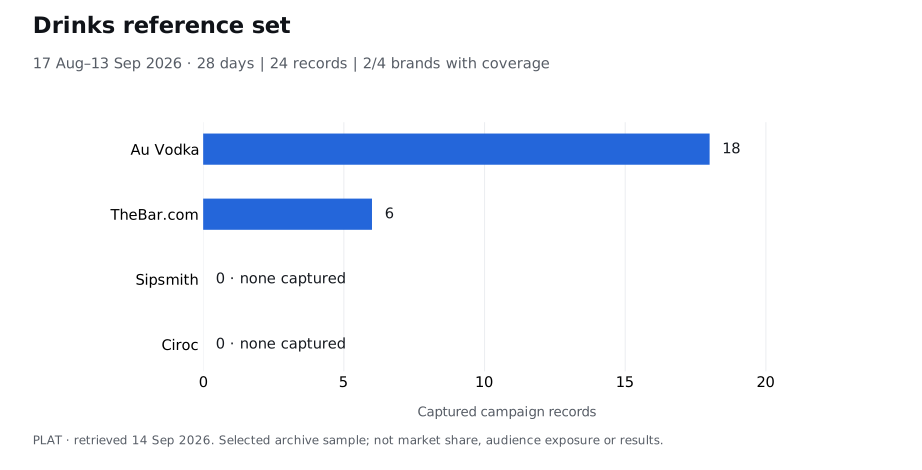
Our recent PLAT reference window, 17 August–13 September 2026, contains 18 Au Vodka campaign records and six from TheBar.com. Sipsmith and Ciroc had no captured records in that window. The 24 records are a small observation set, not an industry sending target.
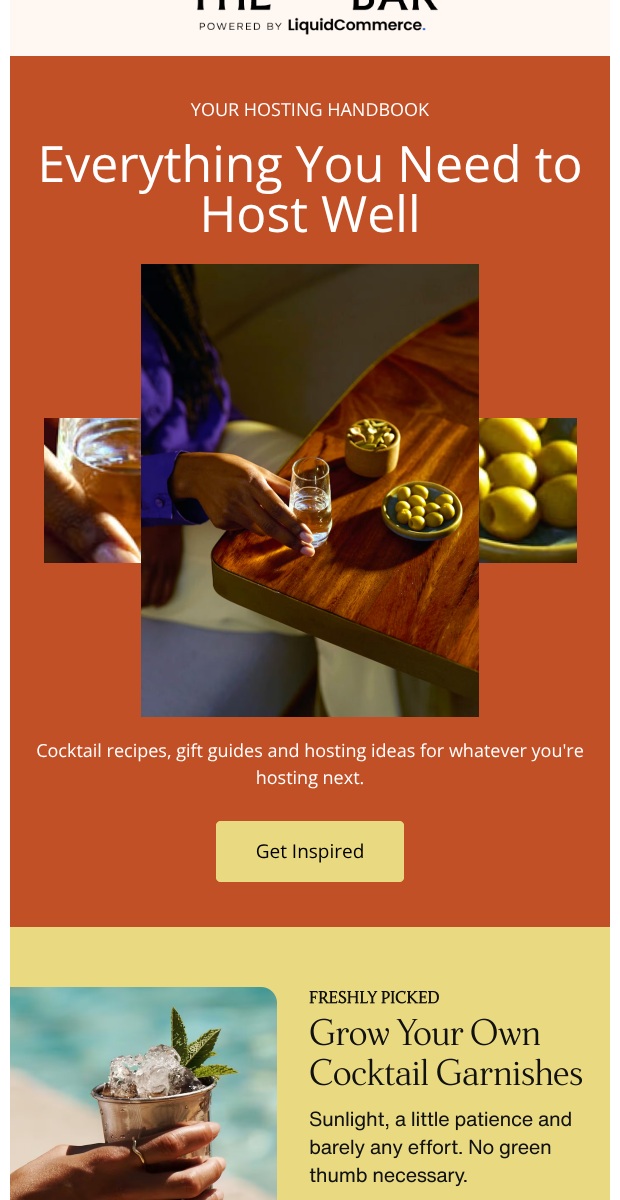
The Bar's “Bookmark this” reference offers a hosting handbook with recipes, gift ideas and occasion content. Its email gives readers several useful reasons to visit before it presents routes to spirits, pre-mixed cocktails and barware.
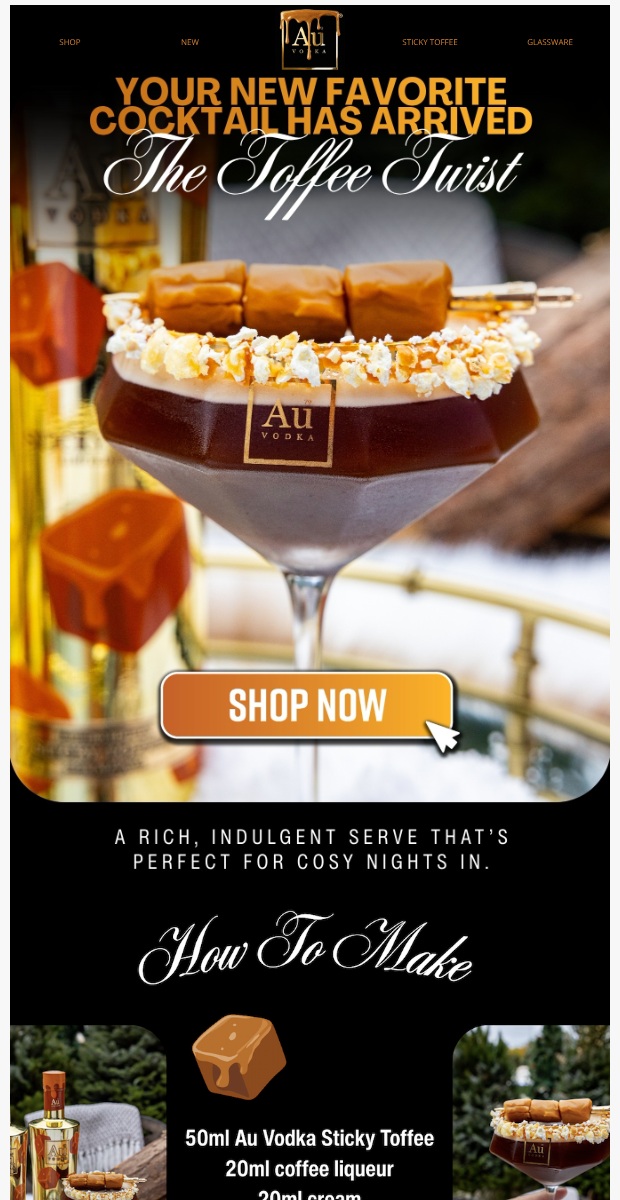
Au Vodka's historical Sticky Toffee recipe email takes a more product-specific approach. It makes the serving occasion visible, then connects that content to the featured flavour and related collections.
Neither record proves a flow exists behind it. The opportunity is to take the communication job, helping someone choose or use a product, and place it where it makes sense in your own customer journey.
Six flows worth prioritising
1. A welcome flow that helps someone choose
Start when a person becomes eligible for your marketing programme. Introduce the range through a small number of meaningful choices: gift, preferred flavour or product format. Avoid asking for a long profile before the customer knows what the brand offers.
A practical starting sequence is an immediate introduction, a product-choice message after two days and a useful example after a further two or three days. These are testing assumptions. Someone who buys should leave the acquisition route promptly; do not keep sending first-order messaging after a purchase.
Offer terms must match the subscriber's market and eligibility. If a signup incentive exists, keep the same terms on the form, email and checkout.
2. Product-interest follow-up with a relevant destination
For identifiable, marketing-eligible visitors, use meaningful product interest to select the next helpful message. A bottle view could lead to flavour detail; an engraving view could lead to the personalisation process. Check tracking and event availability in your actual stack.
Start conservatively: one useful follow-up, after a reasonable interval, with exclusions for a later purchase or a more relevant checkout journey. A view is not a reliable statement that someone wants a reminder, and a passing glance should not create a long sequence.
3. Checkout recovery that answers the blocker
Use the products in the checkout to determine the help. Gift customers may need delivery certainty; other shoppers may need price, contents or payment clarity. Link to the correct cart or current product destination and recheck availability.
A first reminder after several hours and one later follow-up can be a starting test. Do not add an automatic discount simply because the shopper paused. Compare recovery with and without the extra incentive using a randomised eligible audience, if volume permits.
4. Delivery-aware product support
Dispatch is not delivery. Where your integration supplies a reliable delivered event, use it to begin product guidance. Otherwise use a conservative estimate and wording that does not claim the parcel has arrived.
A product-specific message can explain storage, presentation or an approved serving suggestion. A gift purchase may need different information from a self-purchase. Suppress cross-sells while a refund, damage or delivery issue is unresolved.
5. Preference and occasion follow-up
Ask one useful question after a reasonable period: “Was this a gift or something for you?” Provide a clear purpose and let the customer skip it. Keep “unknown” as a valid state.
For a known gift buyer, a later gift guide may be more relevant than a replenishment message. For someone who declared a flavour interest, a new release or accurate availability update may make sense. These are opportunities to test, not assumptions about drinking frequency.
6. A considered re-engagement route
Define lapsing from your own product and occasion patterns. A gift customer who returns once a year has a different cycle from a frequent online shopper. Start with updated relevance, preferences or a new product story; use incentives only where the economics justify them.
Stop marketing when eligibility ends. Where an otherwise eligible customer remains inactive, apply your established suppression policy rather than extending a sequence indefinitely.
A flow map your team can actually operate
| Customer state | Next useful action | Priority exclusion | Primary measure |
|---|---|---|---|
| New eligible subscriber | Product or gift orientation | Already purchased | First-order contribution per entrant |
| Interested visitor | Relevant product information | Checkout or purchase supersedes it | Incremental purchasers per eligible visitor |
| Uncompleted checkout | Resolve the selected-order decision | Later purchase or unavailable product | Net recovered contribution |
| Order in progress | Delivery and service support | Unresolved service issue blocks cross-sell | Delivery contacts and resolution |
| Delivered first order | Relevant help and optional preference question | Unknown delivery or marketing ineligibility | Engagement plus later retained purchase |
| Known gift or product interest | A suitable future occasion or release | Recent purchase or conflicting journey | Repeat contribution at a fixed cohort age |
Make the priority rule explicit: service comes first, purchase confirmation changes the state, and overlapping marketing journeys need one owner. SMS should be reserved for appropriate, consented moments and coordinated with email; it should not automatically duplicate every message.
Carry the acquisition promise into email
A creator video, paid ad or gift guide starts the conversation. The landing page and first email should continue it.
If an ad shows the personalisation process, the destination should show that process and its limits. If a creator introduces a flavour, the welcome email should make that flavour easy to find. Retain the source and creative theme where you can, without claiming complete attribution when identifiers are missing.
For retail discovery, offer a useful reason to visit your site or subscribe, such as an original serving guide or product information, where channel rules allow it. A retailer's customer is not automatically a subscriber in your CRM.
The Salt & Stone playbook describes customers discovering products in one channel and purchasing in another. That is a useful prompt to examine the whole path; it does not let you assign unobserved retail purchases to a particular email. Open Residency, Salt & Stone playbook, p. 7.
The AI planning pack for this guide: the article, source ledger, exact sample counts, an input checklist and an implementation prompt. Upload it to Claude, ChatGPT or any AI you use.
Download the AI packKeep acquisition cohorts fixed and lifecycle states current
Create the acquisition cohort from the first valid order month or a documented seasonal window. Record the first product, offer, acquisition route and declared gift intent. Those are historical attributes.
Keep current status separately: one-order customer, repeat customer, active support case, opted out or currently lapsed. A customer can become a repeat buyer while remaining a member of the same original BFCM cohort.
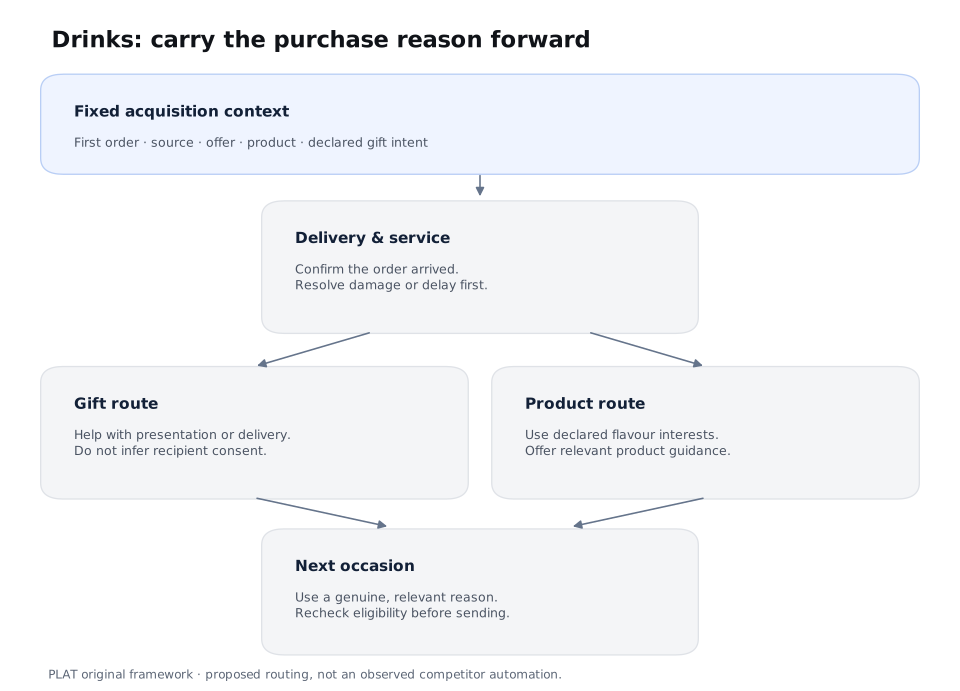
For each cohort, compare second-order rate and contribution at consistent ages. The denominator is all valid first-order customers who have had the full observation period, including those who subsequently returned or refunded the order. Fraud, cancelled and test orders should follow a documented exclusion policy.
Use gift intent as a separate cut, including an unknown group. Do not silently classify every engraved bottle as a gift. It is a plausible signal, not a confirmed customer answer.
Look at 90 and 180 days where they fit the product cycle, then seasonal return where relevant. A short window can miss a perfectly valuable annual gift customer. Conversely, a high repeat rate can still hide poor margins or repeated incentive costs.
What to collect before building
Start with the data your system can support reliably:
- Stable customer and order identifiers, order dates, first-order status and marketing eligibility.
- Product and variant IDs, quantities, net paid amounts and refunds.
- Reliable order, dispatch and delivery states, with service exceptions where available.
- Declared gift or flavour preferences, including when and how they were collected.
- Acquisition source when known, with an explicit unknown category.
- Product-level costs and variable order costs for contribution analysis.
You do not need every field to begin. A clear welcome, purchase suppression and useful post-delivery message can improve the programme's logic before advanced personalisation is available.
A focused first month
In week one, audit entry rules, conflicting messages and the customer data needed for the highest-priority flow. In week two, build or repair the welcome and checkout routes. In week three, add delivery-aware support and a simple preference question. In week four, review early behaviour and set the dates for mature cohort measurement.
Choose one controlled test at a time. For example, test a product-choice welcome message against the current version with the same offer and comparable eligibility. Predefine the purchase window and compare net contribution alongside opt-outs and service issues. The result should answer whether that change helped, not whether two unlike audiences happened to behave differently.
Questions drinks brands ask
Should we use a replenishment flow?
Only where the product, customer preference and observed behaviour support the message. Avoid estimating alcohol consumption from elapsed time. An occasion-led or requested reminder may be more appropriate.
Can a gift recipient enter the buyer's flow?
A delivery address is not a marketing relationship. Treat recipients separately and use an appropriate opt-in route if they choose to engage.
What rules should shape the creative?
Build for eligible adult audiences and the intended market. UK alcohol marketing must not suggest alcohol is necessary for social success or has health benefits. Use responsible occasion context and verify the final creative against the relevant rules. CAP Alcohol Code.
Build a programme around your customers
My lifecycle work includes Au Vodka. I help brands connect creative, segmentation and flows so the customer sees a coherent journey and the team can understand what it produces.
I run lifecycle for Au Vodka and help drinks brands build the journey behind the inbox. Bring your calendar, flows and current numbers; we will map the programme on the call.
Arrange a drinks lifecycle strategy call →Prefer email? george@platagency.com
Download the drinks lifecycle AI pack. Planning peak season? Read the drinks BFCM guide. For more references, explore PLAT.
Sources and method
Research reviewed 14 September 2026. The recent PLAT window is 28 inclusive days, 17 August–13 September. Brand-level records may include variants and market differences; archive dates may be import dates. Two creative references were visually inspected, one historical and one recent. They inform proposed communication jobs, not claims about the brands' actual flows or performance. The customer model and test plan are original PLAT recommendations; no individual-level purchase data was supplied.
Bring this to your brand.
I run lifecycle for Au Vodka and help drinks brands build the journey behind the inbox.
Arrange a drinks lifecycle strategy call Or email george@platagency.com