Table of contents
What the PLAT drinks sample shows Two offers worth studying Build three routes into the promotion A manageable 2026 campaign sequence Build the flow before acquiring the customer Follow the BFCM acquisition cohort into the next season Keep product value and commercial value together Questions drinks teams ask Put this into your drinks programme Sources and methodFor spirits and premium drinks brands, a useful Black Friday strategy starts with the reason for the purchase. Someone choosing a personalised gift needs different help from a customer returning for a favourite flavour. The offer, landing page and follow-up should reflect that difference.
This guide uses historical campaigns from Au Vodka and The Bar to build a practical BFCM programme for 2026: acquire the right adult customers, make the gift or product choice clear, protect contribution and plan what happens after delivery.
Black Friday is 27 November 2026. Cyber Monday is 30 November. Set your own promotion window explicitly; the customer journey continues after it closes.
What the PLAT drinks sample shows
PLAT's canonical aggregates contain 53 campaign records across Au Vodka and TheBar.com for 1 November–1 December 2025: 39 and 14 respectively. Two further queried brands, Sipsmith and Ciroc, had no captured records in that window. This is a small, deliberately selected alcohol reference set, with UK and US market examples.
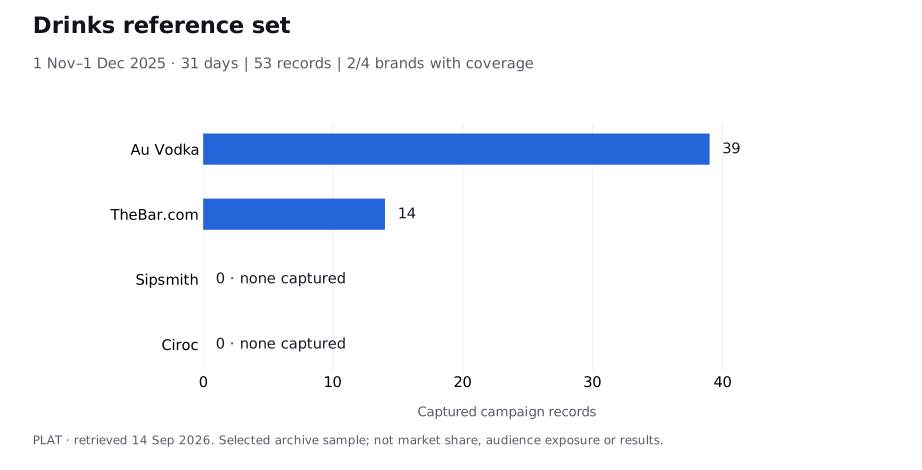
The useful finding is the range of purchase reasons. The selected emails include a glassware gift, bottle engraving and a seasonal recipe. A drinks campaign can answer a different question on each send while staying within one commercial plan.
There is broader evidence for considering value beyond a deeper reduction. Klaviyo reported an average BFCM discount of 26.2% in 2025, versus 29.1% in 2024, across its analysed ecommerce population. This is context, not a recommended drinks discount. Klaviyo BFCM recap.
Two offers worth studying
Au Vodka makes the added item visible
An archived Au Vodka email dated 24 November 2025 pairs Cosmic Berries with a free highrise glass. The hero shows the bottle and glass together, names the included item and gives the reader one main shopping action. Additional deals sit below the main proposition.
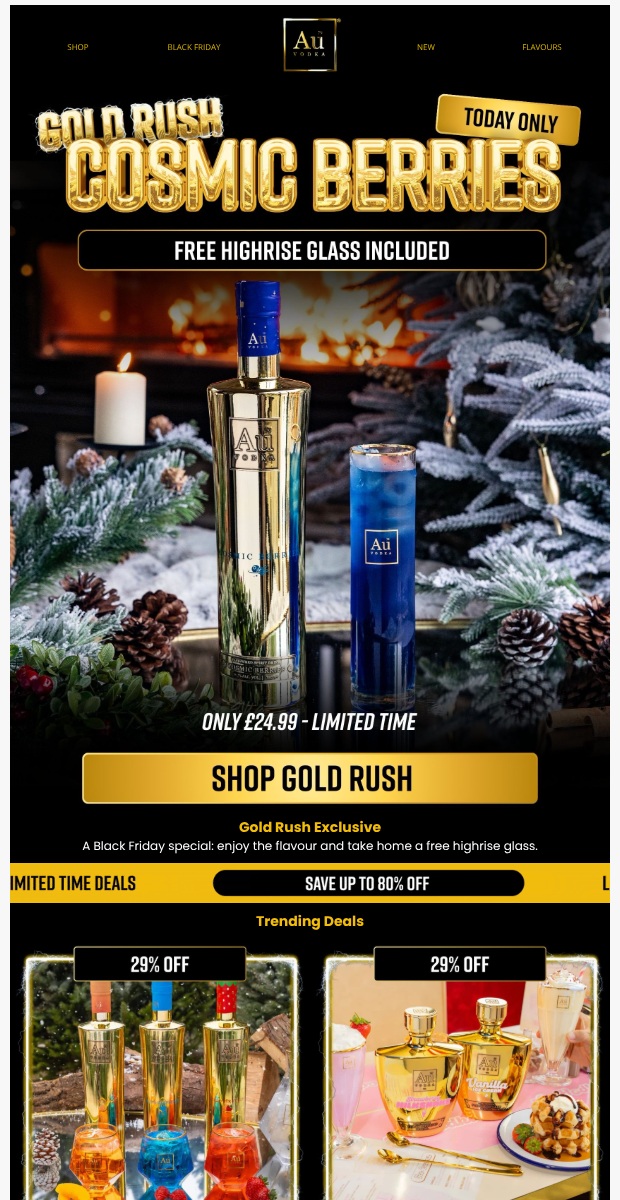
The transferable idea is to show the complete purchase. If your offer includes packaging, an accessory or another approved benefit, photograph the actual bundle. Explain what is included before asking someone to calculate the value.
A free item still has a cost. Include its landed cost, packing time, shipping implications and likely breakage when comparing it with a price reduction. Test against your current offer on retained contribution per eligible visitor, not basket value alone.
The Bar turns personalisation into the reason to act
The Bar's 27 November reference promotes free engraving on qualifying bottles. Its creative moves from the finished gift to a short explanation of how engraving works. The extracted terms specify a code, eligible purchases and an offer window; this is a US reference.
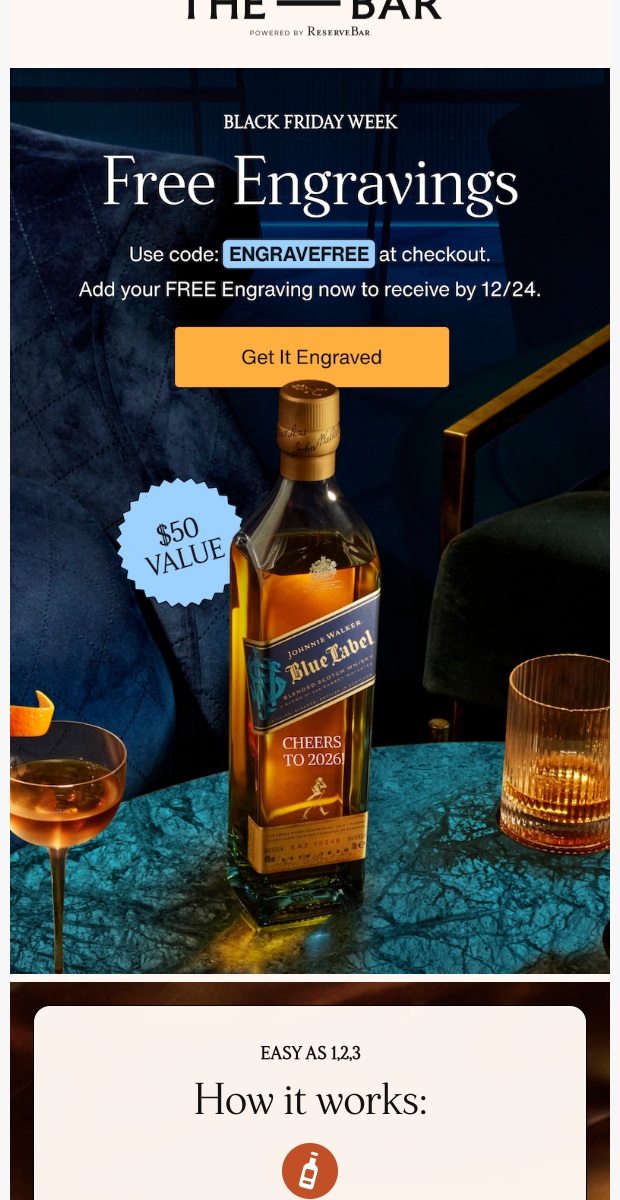
For a premium drinks brand, personalisation can resolve the gift decision: which bottle, what message and when it will arrive. Build those answers into the landing page. Show the character limit, an accurate preview and the personalisation deadline where they affect the order.
This suggests a useful acquisition test: a gift-selection page versus a generic sale collection, using the same eligible offer. Keep the creative promise and destination aligned. Do not describe every visitor as a gift buyer merely because they arrived through a gift-themed ad.
Build three routes into the promotion
| Customer need | Acquisition destination | Useful information to retain | Next message |
|---|---|---|---|
| Choosing a gift | Gift guide or personalisation collection | Declared gift intent, market, first product | Gift options, delivery and packaging |
| Exploring a flavour | Flavour comparison or relevant product page | Declared taste preference or product interest | Product details and serving context |
| Returning for something familiar | Relevant in-stock range | Previous eligible purchase and current availability | A clear, applicable seasonal benefit |
Use optional preference choices to improve relevance. A link click is an interest signal; a customer's answer is stronger evidence of intent. Neither gives you permission to contact a recipient whose details were entered only for delivery.
Give each route its own creative brief. A gift route could open with “A gift with their name on it”, supported by a close-up of the finished personalisation and a clear deadline. A flavour route should explain the product difference. A returning customer usually needs less introductory brand copy.
A manageable 2026 campaign sequence
| Planning window | Message job | Audience decision |
|---|---|---|
| 19 October–1 November | Agree offer economics and fulfilment | Decide which products and markets can support the offer |
| 2–15 November | Build gift and flavour destinations | Capture useful preferences from eligible subscribers |
| 16–22 November | Help shoppers shortlist | Send the relevant gift or product guide |
| 23–26 November | Deliver any genuine early access | Use defined access rules and a working destination |
| 27 November | Launch the main offer | Explain inclusions, exclusions and delivery expectations |
| 28–29 November | Resolve the remaining decision | Show personalisation, a comparison or the complete gift |
| 30 November | State the actual closing time | Send only where the offer remains applicable |
| 1 December onwards | Support the purchase | Route by order, delivery and declared intent |
This is a proposed sequence, not an instruction to send eight emails to everyone. Recheck purchases and stock before each campaign. Once someone buys, remove them from messaging that still treats them as a first-time prospect.
For a small team, prioritise four strong jobs: selection, launch, decision support and close. Extra sends need a useful reason, an eligible audience and operational capacity.
Build the flow before acquiring the customer
The automation should carry the purchase context forward.
| Entry and timing hypothesis | Message | Branch or exit |
|---|---|---|
| Eligible marketing signup | Welcome and relevant gift or flavour guide | Skip the first-order offer if already purchased or ineligible |
| Checkout started without a later purchase | Help complete the selected order | Exit on purchase; check price, stock and market before sending |
| Paid order | Confirmation through the existing service journey | Stop conflicting acquisition reminders |
| Delivery confirmed | Relevant care, serving or gift information | Prioritise support if damaged, delayed or disputed |
| Gift intent declared | Gift presentation and service help | Do not assume the buyer consumed the product |
| A later relevant occasion | A fresh reason to browse | Use consent, preferences and recent activity; suppress opt-outs |
Avoid treating an alcohol bottle as a fixed daily-use consumable. “You must be running low” is a weak inference from order date and quantity. An occasion, declared preference or requested reminder offers a more defensible starting point.
The AI planning pack for this guide: the article, source ledger, exact sample counts, an input checklist and an implementation prompt. Upload it to Claude, ChatGPT or any AI you use.
Download the AI packFollow the BFCM acquisition cohort into the next season
A cohort is a fixed group defined by the conditions when customers entered it. For this campaign, define the BFCM cohort using each customer's first valid purchase within your documented offer window. Keep that membership stable after they buy again.
Alongside it, store the first product, acquisition source where known, first-order offer and declared gift intent. Current lifecycle status changes separately: first-time buyer, repeat buyer, service issue or lapsed customer. A repeat order should not overwrite the original acquisition story.
| Cohort question | Measure | Decision it informs |
|---|---|---|
| Did gift-led acquisition produce useful customers? | New buyers and contribution by declared gift intent | Whether to expand the gift route |
| Did the incentive pay for itself? | Contribution after product, gift, variable fulfilment and acquisition costs | Whether to keep the offer |
| Did customers return? | Second-order customers divided by all eligible first-order customers at the same age | Whether follow-up merits further investment |
| Was the second order another gift? | Declared intent on later orders where available | Which next occasion or product story is relevant |
| Did service friction erase the value? | Refunds, breakages and support issues by offer | What operations must fix before scaling |
Read 60-, 90- and, where useful, 180-day outcomes only when the cohort has reached those ages. Keep first-order customers who later refunded in the acquisition denominator and account for the refund in value. Otherwise a weak offer can look better by removing its failures.
If a gift cohort repeats less often than a self-purchase cohort, that alone does not make it worse. Compare contribution, acquisition cost, seasonal opportunity and the length of the observation window. Do not infer individual retail purchases from a decline in online reorders.
Keep product value and commercial value together
Nima Jalali's Salt & Stone interview playbook places product design, scent and performance at the centre of premium positioning. The useful application here is to explain what makes the gift or flavour worth choosing before introducing the incentive. This is an adaptation from a different category. Open Residency, Salt & Stone playbook, pp. 5–7.
Roman Khan's supplied playbook distinguishes reported profit from cash available after working-capital needs. For BFCM planning, use that as a prompt to check the stock and cash consequences of the offer alongside the campaign forecast. An email dashboard cannot answer those questions alone. Open Residency, Dividend-First playbook, p. 7.
Questions drinks teams ask
Should every customer receive the same Black Friday offer?
Start with eligibility and the purchase decision. Gift buyers may need personalisation help; existing buyers may need relevant availability. Test offer differences only where commercial rules and the customer experience support them.
Can we reuse a successful-looking competitor promotion?
Use it to understand the mechanism. PLAT records do not establish profitability or legal approval. Check your own terms and markets. UK alcohol advertising must avoid targeting under-18s or encouraging excessive consumption; promotional content also falls within those rules. CAP Alcohol Code.
What should happen after Cyber Monday?
Support delivery first. Continue with gift or product context, then measure the acquisition cohort at consistent ages. Keep discounts out of service emails unless the communication is properly treated as marketing.
Put this into your drinks programme
I work on lifecycle marketing for Au Vodka and help ecommerce brands connect campaign creative with the customer journey behind it. If your BFCM plan needs clearer segments, better flows or a useful view of what new customers do next, let's discuss the programme.
I run lifecycle for Au Vodka and help drinks brands build the journey behind the inbox. Bring your calendar, flows and current numbers; we will map the programme on the call.
Arrange a drinks CRM strategy call →Prefer email? george@platagency.com
The AI planning pack for this guide: the article, source ledger, exact sample counts, an input checklist and an implementation prompt. Upload it to Claude, ChatGPT or any AI you use.
Download the AI packContinue with drinks email flows from first order to the next occasion or explore campaign references in PLAT.
Sources and method
Research reviewed 14 September 2026. PLAT figures use exact canonical brand queries for 1 November–1 December 2025 inclusive. Archive dates can reflect import time; they do not establish the original send schedule. Coverage is incomplete, variants may remain and the selected brands do not represent the drinks market. Two BFCM visuals were inspected for this article. Examples establish communicated creative, not conversion, incrementality or revenue. All 2026 plans and proposed flows are original recommendations. Founder-playbook lessons are attributed interview accounts; no founder revenue claims are used as benchmarks.
Bring this to your brand.
I run lifecycle for Au Vodka and help drinks brands build the journey behind the inbox.
Arrange a drinks CRM strategy call Or email george@platagency.com